Efficiency & Resilience
Efficiency and Resilience
The turf industry has transformed. Now it faces a challenge efficiency alone can't solve
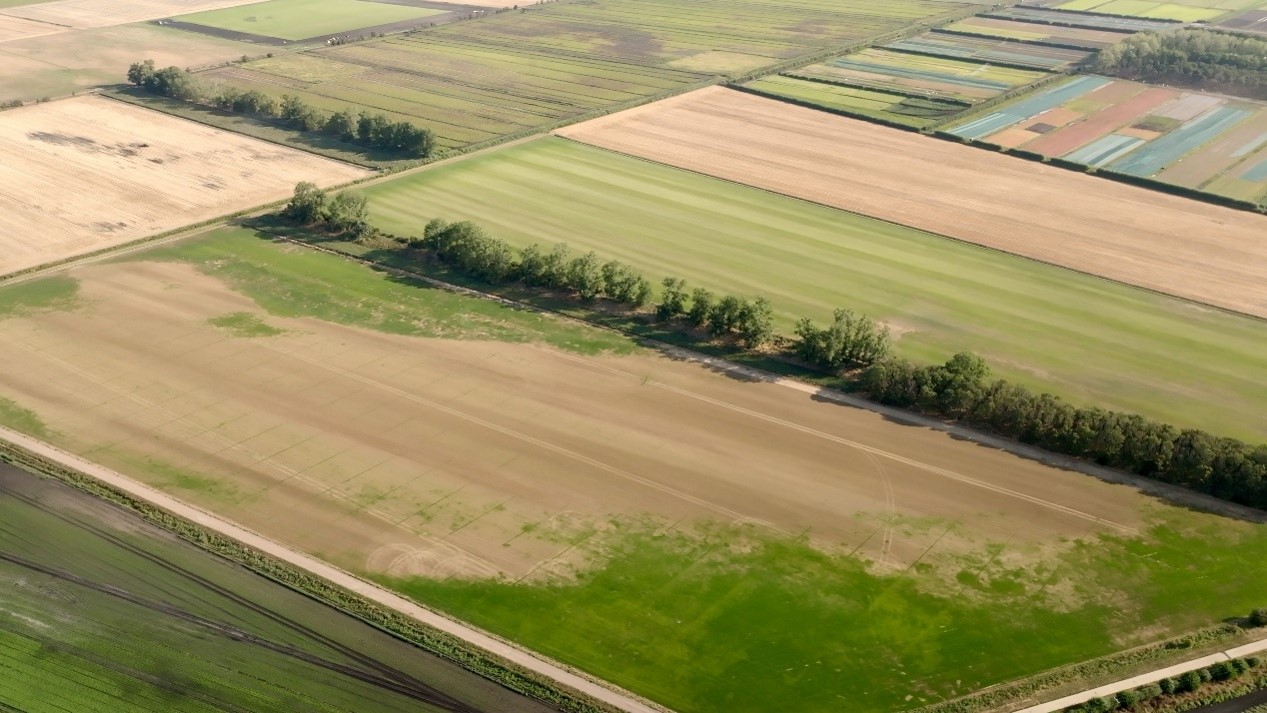
The turf industry of today is almost unrecognisable from the one operating at the turn of the century.
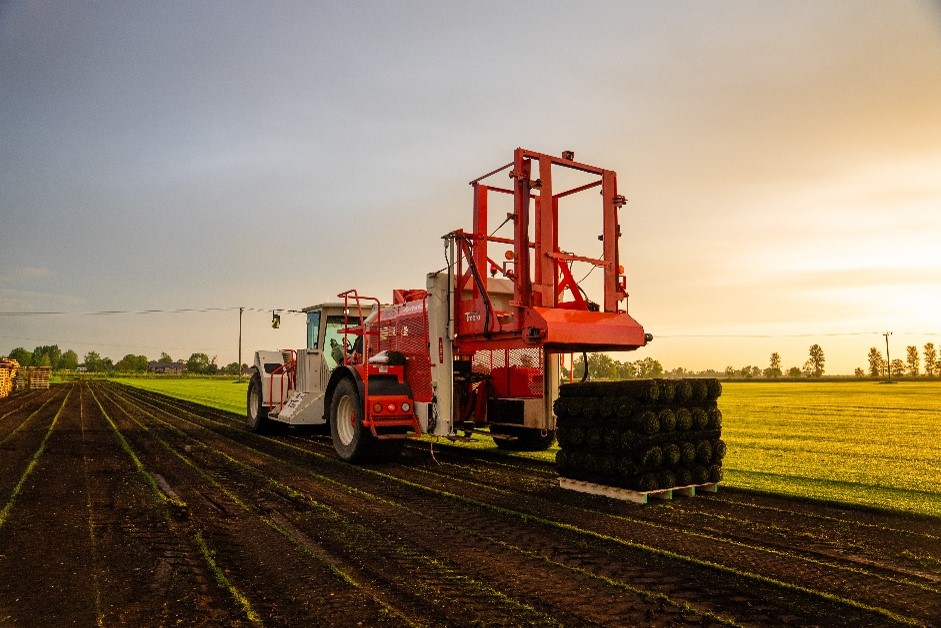
Harvesting that once required turf to be stacked by hand can now be highly automated. Modern machinery operates with far greater precision. GPS technology reduces unnecessary overlap. Irrigation can be informed by real-time weather and soil-moisture data, while soil testing and variable-rate spreading allow fertiliser to be applied according to actual crop requirements.
For more than 25 years, turf growers have invested, innovated and become significantly more efficient.
But the extreme growing conditions experienced during 2026 have exposed an uncomfortable reality. There are some challenges that greater efficiency alone cannot solve.
And as increasingly volatile weather changes the conditions in which turf is grown, we believe the next phase of innovation will increasingly be about something else: resilience.
25 years of increasing efficiency
The turf industry has not stood still. Advances in tractors and harvesting equipment have increased productivity and reduced many of the physical demands once placed on farm teams. Irrigation technology has evolved considerably.
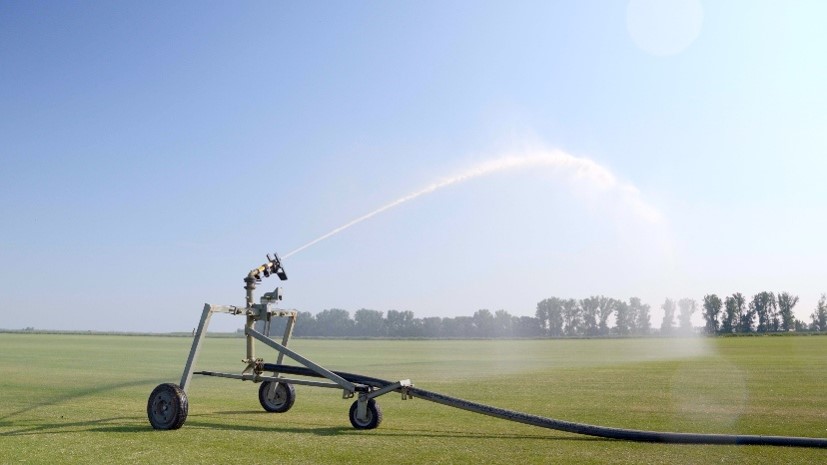
At Harrowden, Raindancer technology is used on irrigation reels to control the timing and application of water more accurately. Sencrop weather stations, forecasts and soil-moisture probes help our teams understand when irrigation is actually required.
Soil testing and variable-rate spreading mean fertiliser can be applied according to crop requirements rather than treating every area in exactly the same way.
These developments have enabled growers to make increasingly intelligent use of water, fertiliser, fuel, machinery and people. So improving consistency and reducing unnecessary inputs and waste.
But there is another important consideration too. Modern turf production cannot simply respond to more challenging conditions by continually applying more water, more fertiliser or more inputs.
Growers have a responsibility to farm efficiently and responsibly. We must use resources according to what crops genuinely need and reduce unnecessary inputs wherever possible.
That means the challenge facing the industry is no longer simply how to produce more with less.
Increasingly, it is how to remain productive when some of the resources growers depend upon become less predictable.
When efficiency meets its limits
Water provides perhaps the clearest example. Turf farms can be equipped to irrigate crops on a rotational cycle across large growing areas. In normal conditions, that allows available water and equipment to be moved efficiently between fields.
But during prolonged periods of extreme heat and drought, the frequency with which crops require water can increase dramatically. A system capable of working across a farm on approximately a ten-day irrigation cycle may face conditions in which turf requires water every few days.
Building sufficient infrastructure to meet that level of peak demand across an entire farm would require enormous investment for conditions that may occur for only part of the year.
And infrastructure is only one side of the equation. Even with additional pumping and irrigation capacity, growers cannot apply water that simply isn’t available.
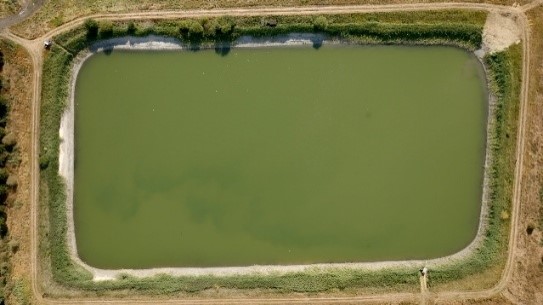
Access can be a challenge too. On farms which use ditch networks to move irrigation water around the site, falling water levels can make it considerably more difficult to get water to particular growing areas, requiring additional pipes, transfers and water management.
High temperatures can increase water demand at the same time as evaporation increases and available water resources come under greater pressure.
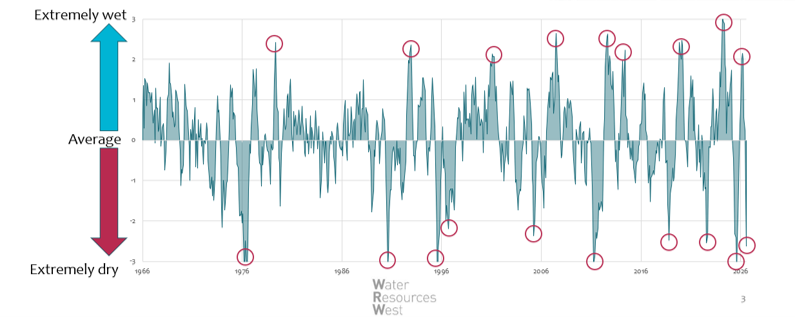
Weather Whiplash graph. Rainfall over the past 60 years for a representative catchment in central England tells a story of "weather whiplash". Extreme wet and dry periods are becoming more common, with conditions changing more quickly than in the past. Source: UK Centre for Ecology & Hydrology (UKCEH) SPI-6 rainfall data. Further analysis and visualisation by Water Resources West.
Analysis provided to Harrowden by MapleSky’s environmental data scientist Dr Tim Farewell shows the time between the start and end dates of the theoretical thermal growing season in Eastern England has increased by approximately seven days per decade.
It demonstrates the limit of even increasingly sophisticated technology: efficiency can help growers make the best possible use of a resource, but it cannot create more of that resource.
2026 – an exceptional year, or a sign of what’s ahead?
This is where the experience of 2026 becomes particularly important. The exceptionally hot and dry conditions experienced this summer placed significant pressure on turf production across the UK, but longer-term climate data suggests growers need to think beyond one difficult summer.
Average growing seasons have increased from around 222 days in the 1980s to approximately 244 days during the 2020s.
On paper, that sounds positive.
The reality on the ground is more complicated.
Over the same period, average summer temperatures have increased, spring and summer rainfall have fallen and the number of days experiencing significant summer soil-moisture deficits has risen considerably. Winters, meanwhile, have become wetter.
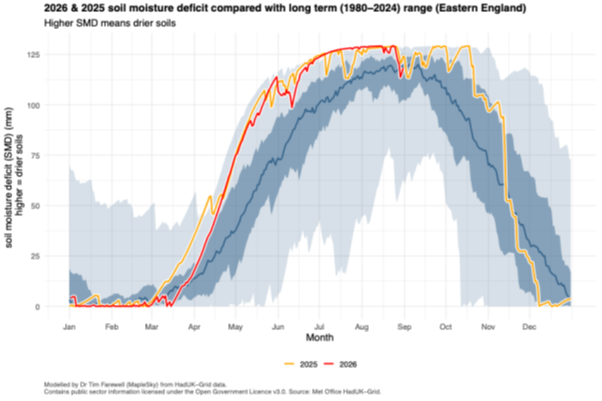
Soil moisture deficit across Eastern England: Mean daily soil moisture deficit (SMD) during 2026 (red line) compared with the historical range for 1980–2024, alongside 2025 (orange line) and the long-term median. The graph shows 2026 rising rapidly from spring and remaining at the upper end of the historical range through much of the summer. Source/analysis: Dr Tim Farewell, MapleSky Ltd using Met Office HadUK-Grid data.
For turf growers, that creates a contradiction. Temperature is only one part of successful turf production. Soil conditions, water availability, machinery, labour and suitable access to the land all need to come together at the right time.
So while temperatures may theoretically allow grass to grow for longer, the windows in which conditions are actually suitable for successfully establishing and producing a crop can become harder to predict.
Dr Farewell said: “The UK climate is changing to one with an earlier start, and later end, of the theoretical grass growing season. But this does not necessarily mean easier growing conditions. With springs and summers both becoming much hotter and drier, this increases both soil moisture deficits and water demand.
At the same time, wetter winters create a different set of challenges. It is the increasing extremes of those conditions that growers will need to adapt to.”
Our own farm teams are already seeing those changing patterns first-hand.
Late-spring sowings can struggle to establish before high temperatures arrive, while drought followed by excessive autumn rainfall can compress the window in which conditions are suitable for sowing.
And when a crop fails to establish as expected or is damaged by difficult growing conditions, the consequence isn’t necessarily just a delay. It can mean additional renovation, greater waste and more work before that area is ready to produce turf again.
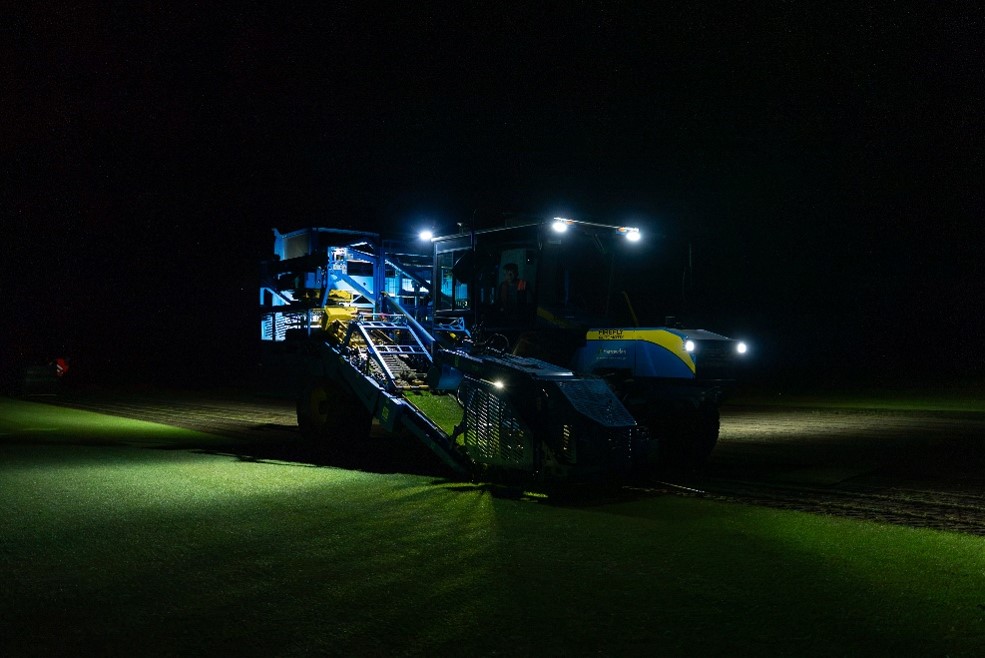
Warmer conditions also affect how turf is harvested. We typically move to night-time harvesting between early June and early September, depending on conditions, allowing turf to be loaded and delivered the same day to reduce the risk of turf heating once it has been stacked on pallets.
The economics of growing turf have changed too
All of this is happening against another changing backdrop. Many of the underlying costs associated with agricultural production have risen substantially over the past 25 years.
Data we have compiled using Office for National Statistics and Defra figures shows that between 2000 and 2025, wider agricultural input costs increased by around 131%, while red diesel rose by more than 200%, wages by around 230% and compound fertiliser by more than 300%.
Over approximately the same period, historic purchasing data from within the business shows that the ex-field price paid for turf increased by approximately 86%.
The comparison does not mean every turf grower has experienced identical cost or pricing movements. Prices vary according to supplier, customer and commercial model, while individual input costs can fluctuate considerably from year to year.
What it does illustrate is the wider economic environment in which the sector has spent decades driving greater efficiency.
For years, investment in technology, productivity and better growing methods has enabled turf businesses to respond to changing costs and market conditions.
But what happens when the variable that changes is the growing environment itself?
The next challenge is resilience
None of this means the industry’s drive for greater efficiency is over.
Better water management, increasingly precise irrigation, improved grass varieties, smarter use of data and further advances in machinery all have an important role to play.
But after decades of focusing on how to become more efficient, the experience of recent years suggests the next phase of innovation cannot be measured by productivity alone.
Efficiency is about doing more with the resources available. Resilience is about remaining productive when the availability and reliability of those resources change.
That means continuing to invest and innovate, but with an increasing focus on how turf production adapts to less predictable growing conditions – from the way water is managed and crops are established to the technology, data and expertise used to make decisions.
Stuart Ridd-Jones, Director at Harrowden, said: “Turf production has changed enormously over the last 25 years and the industry should be proud of how far it has come. It is more sophisticated, more precise and more efficient than it has ever been.
“But 2026 has shown us that there are some things efficiency alone cannot solve.
“We can invest in better machinery, use data to make smarter decisions and apply water and fertiliser with greater precision. We can continue improving the way we grow, and we absolutely will.
“What we can’t do is manufacture water that isn’t available or control the conditions in which our crops have to grow.
“The challenge now is not simply becoming more efficient. It’s making sure we’re adapting and building resilience into the way we grow for the conditions we’re increasingly likely to face.”
The summer of 2026 may eventually be remembered as an exceptionally challenging growing season.
But it may also prove to be the point at which a highly efficient industry was forced to confront a different question.
After 25 years of transforming how turf is grown, how does the sector adapt when the environment it’s growing in is transforming too?
Have a Question?
If you want to talk over your plans or discuss a bespoke seed mix or turf application please get in touch.